
Crosslinking in Softgel Capsules: An Intro
Most quality failures give you some warning. Unfortunately, crosslinking does not. By the time it appears in dissolution, the cheapest options for fixing it are already gone.
This article covers what crosslinking actually is, why it causes dissolution to fail even when the active ingredient is perfectly stable, how the USP expects you to test for it, and why the only reliable defense is designing it from the start.
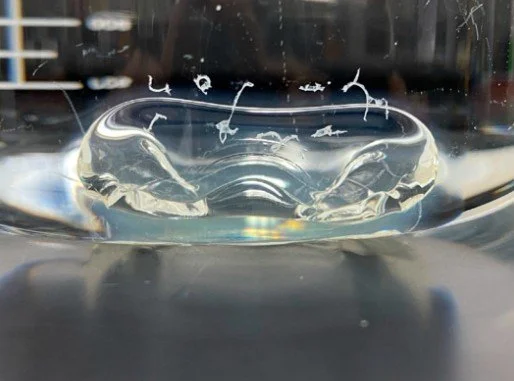
A crosslinked softgel capsule.
Images courtesy of SOTAX Pharma Services.
What Gelatin Crosslinking Actually Is
Gelatin shells dissolve readily in warm aqueous media because the protein chains that make up the shell are water-soluble due to their molecular weight distribution. Crosslinking changes that. It occurs either as an internal or external process: internal, when gelatin chains self-crosslink under the impact of heat and humidity, or, more often, external, when reactive molecules form additional covalent bonds between those chains, typically at the free amino groups of lysine residues.
The driver is almost always aldehydes, and the sources are numerous: oxidized excipients in the fill, residual impurities, peroxides, or the API itself under certain degradation pathways. Aldehydes don´t get added on purpose; they accumulate over time as oxidative degradation products, and the reaction is accelerated by heat, humidity, and light during processing and storage.
The result is a pellicle: a thin, tough, water-insoluble membrane on the inner surface of the shell. It is the visible signature of a capsule that has crosslinked and a shell that has become progressively more resistant to hydrolysis and enzymatic digestion.
Want to learn more? Our online course covers root causes, detection strategies, and how to build the question into your method before it costs you a batch.
How a Pellicle Causes Dissolution Failure
When a crosslinked capsule is subjected to a dissolution test dm, the pellicle swells but doesn´t dissolve. Rather than releasing the fill, the shell behaves like a sealed sac, trapping the active ingredient inside or slowing its release to a crawl. In the dissolution apparatus, this reads as slow, incomplete, or highly variable drug release
That failure is often an in vitro artifact. The digestive enzymes present in the human gut, principally pepsin in the stomach and pancreatin in the intestine, can break down the crosslinked protein and free the fill. A batch that fails on the bench may still perform acceptably in the body. The test fails; the product, in practice, might not, but there is no way of knowing for certain
Crosslinked vs Non-Crosslinked: What You Are Looking at
The difference is easy to see once you know what to look for. A healthy shell ruptures and releases its contents, leaving little behind but spent, translucent shell material. A crosslinked shell does the opposite: it swells into a tough, water-insoluble membrane — the pellicle — that keeps its form while the fill stays locked behind it. The two capsules above went through the same conditions; only the crosslinked one is still holding its cargo.
Here in the image below, both capsules went through the same dissolution test, yet only one released its contents. The capsule on the right behaved normally: its gelatin shell dissolved and freed the fill, which is exactly what should happen. The capsule on the left had crosslinked. Aldehydes had formed extra bonds between the gelatin's protein chains, turning the inner surface into a pellicle, a tough, water-insoluble membrane that no longer dissolves. So instead of releasing, the shell swelled, held its shape, and sealed the reddish fill inside. That trapped fill is what a crosslinking-driven dissolution failure actually looks like: not a damaged or odd-looking capsule, but one that appears normal and simply refuses to let go of its contents.
What the USP Says About Testing for Crosslinking
Pharmacopeial guidance now treats crosslinking as a named, expected phenomenon rather than an anomaly. The most relevant reference is the revised USP General Chapter 1094 on capsule dissolution and related quality attributes, effective December 1, 2023. It introduced a dedicated crosslinking section that names the key indicators, pellicle formation, and altered dissolution rates, and points to analytical methods such as UV-Vis spectroscopy and FTIR for confirming that crosslinking, and not something else, is the cause.
The practical mechanism is two-tier dissolution testing, set out in the dissolution framework of USP <711>>:
Tier 1: the test is run in the standard dissolution medium specified in the monograph (Tier 1 ).
Tier 2: used only if Tier 1 fails due to crosslinking, an enzyme selected for the pH of the medium is added to digest the pellicle, pepsin in acidic conditions, or pancreatin at higher pH. If the capsule then meets the dissolution specification, the failure can be attributed to crosslinking rather than to a genuine loss of bioavailability. Critically, enzymes may only be introduced when there is documented evidence of crosslinking.
Two caveats are worth stating plainly. First, authorities may not accept the enzyme approach without reserve, and further data may be required to support the unaffected performance of a crosslinked capsule. Second, the appearance of crosslinking under accelerated conditions does not always mean it will occur during long-term storage at 25°C/60% RH (a point we cover in more depth in our guide to softgel stability testing). The enzyme step is a diagnostic, not a guarantee.
Want to keep crosslinking off your critical-issues list from day one? Our online course covers root causes, detection, and the shell formulation choices that prevent the problem rather than manage it.
Why Prevention Beats Tier-II Testing
Two-tier testing is a safety net, but relying on it as a strategy has a hidden cost. Reaching for enzymes means crosslinking has already been baked into the product, and the team is now negotiating with the analytics to prove the capsule still complies with specifications. That is a defensive position, and it usually arrives late in development when options are narrow and timelines are tight.
The stronger strategy is to prevent crosslinking from establishing itself in the first place, and that work happens early, during fill and shell formulation. The decisions that matter are deliberate ones: selecting a low-aldehyde excipient grade, optimizing the plasticizer type and amount, screening fill excipients for reactive impurities, controlling residual contaminants, and selecting the right gelatin grade. Setting drying, packaging, and storage conditions that keep heat and humidity in check are secondary measures. Crosslinking is rarely a dramatic failure. It is a slow one, treating it as a formulation question from day one, rather than an analytical issue. At the end, it is what separates a robust softgel program from a fragile one.
Our online softgel course is now live!
After years of requests, we've packaged our expertise into comprehensive training courses:
+ Practical formulation knowledge based on 15+ years of experience
+ Solutions to common quality issues like leakage and crosslinking
+ Available on-demand access—learn whenever and wherever you want
FAQs: Crosslinking
-
Crosslinking is driven by aldehydes that form additional covalent bonds between gelatin protein chains. Those aldehydes come from oxidized fill excipients, impurities, peroxides, or the API itself, and the reaction is accelerated by heat, humidity, and light.
-
Affected capsules can look, feel, and smell completely normal. The problem is internal to the shell chemistry and typically only reveals itself as a dissolution failure, often late in stability rather than at release.
-
Not necessarily. Gut enzymes such as pepsin and pancreatin can digest the crosslinked pellicle, so a capsule that fails on the bench may still release adequately in vivo. Two-tier testing exists precisely to separate a crosslinking artifact from a genuine bioavailability problem.
-
A method in which a capsule is first tested in standard medium (Tier 1) and, if it fails, retested with an enzyme added to digest the pellicle (Tier 2). Normal release in Tier 2 points to crosslinking as the cause, though regulators may ask for additional supporting data.
-
Largely, yes, and prevention is far more reliable than correction. Choosing a low-aldehyde excipient grade, optimizing the plasticizer type and amount, screening fill excipients for reactive impurities, selecting appropriate gelatin grade, and managing storage humidity and temperature all reduce the risk before a pellicle can ever form.